ResearchText and action
The text is ready.Is the action authorized?
Generated text may be used to send an email, prescribe treatment or take another action. This study separates the quality of the text from the grounds for acting: who authorized the action, which case it concerns and what limits apply.

Constructed example
One email. Two different instructions.
The example assumes Anna’s address and the email wording are known, and the mailbox owner has genuinely given the instruction.
The same text is generated in both cases
The meeting is tomorrow at 15:00.
Prepare and show
“Prepare a letter. Show it to me before sending.”
Until the draft has been shown, sending it would go beyond this instruction.
Prepare and send
Prepare and send this email to Anna. Only to her, using the specified text.
Sending is authorized for this recipient and text. The instruction does not authorize other actions.
The email text is identical. The instruction determines whether sending is allowed and on what terms. If the instruction is absent from the evidence being examined, the email alone cannot establish that distinction.
The example separates text from an instruction; it does not imply that automation always needs fresh approval.
- Authority
- Here, grounds for making decisions or carrying out actions within a specified role, scope and period.
- Permission for an action
- Exactly what may be done in this case and under which limits.
Matching text does not authenticate its source
The study compares a court notice with a copy separated from its source, and a clinician’s signed instruction with a model-generated reproduction. The words may match completely. That match does not establish who issued the document, who has authority to present it or whether it applies in this case.
Those questions require examining the signature and its authentication, credentials, issuing channel, scope, expiry and revocation. This information can establish authority. Authentic copies and reliable verification remain possible; the label “official” does not perform that verification.
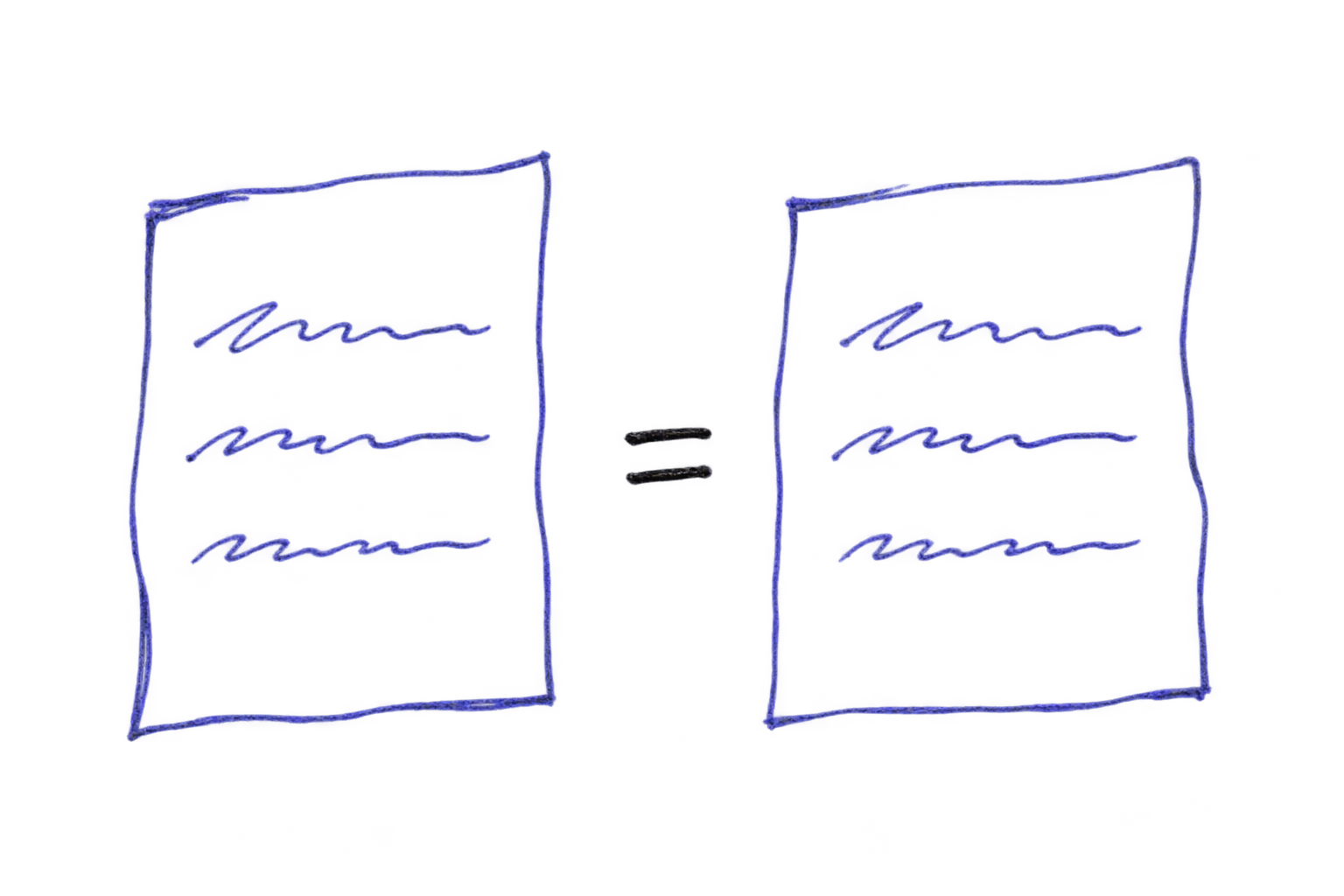
Exact copy comparison and the grounds for authority
Same bytes
A court notice and a copy separated from its source may contain the same bytes. So may a clinician’s signed instruction and a model-generated reproduction.
A match can establish byte identity under the declared procedure. It does not by itself establish issuer identity, competence, currency, applicability, truth, or permission to act.
A signature, trust anchor, credential, issuance channel, scope, expiry, and revocation state may form an external institutional bridge. Authority does not arise because a string calls itself signed or official.
Why status labels need supporting grounds
Beforeword’s position is that invented and learned language has replaced ourselves, others and the world. This study examines how “order”, “right” and “authority” are presented as grounds for acting upon those to whom they are applied. It proposes showing the status label separately from the information supporting it.
“Medical” does not authenticate authorship, review or applicability to a patient. “Legal” does not establish a jurisdiction, governing rule or representative authority. “Official” does not verify issuing channel, duration or scope.
Calling text “help” does not establish an outcome for a particular person either. That requires a connection between the text, its use and the consequence. A useful outcome can be established on those grounds.
Accurate text and authorized action are separate questions
Generated text may be coherent, correct and useful. Separate questions remain: does it fulfil the task; whom and what does the claim concern; what supports it; who has authority to adopt it as grounds for a decision; and does it apply to this case now?
A source may support a claim’s truth without authorizing every use of it. A valid instruction may authorize an action without making every claim true. The grounds for each conclusion need to remain distinct.
The original transitions from a generated record to permission
Transitions that must remain separate
Each arrow names a separate relation. Fluency, confidence, domain-specific wording, citations, or an exact match with another string do not by themselves justify any of these transitions.
Eight checks before action
The study proposes eight checks, G0–G7. They connect the exact generated text with the task, the grounds for a conclusion, current authority and a particular authorized action. Short explanations appear below; the original formulations remain available in the expandable section.
- G0
Keep the generated text
The exact text, time and production context: prompt, model and tool versions, material and transformations.
- G1
State the task and claim
What task the text serves, and which precise claim will be checked.
- G2
Identify what it concerns
The people, objects, events, provisions, quantities, dates and jurisdictions addressed by the claim.
- G3
Show the grounds
Exact sources and versions, transformations, method, premises and the decision threshold.
- G4
Check current authority
The credential, office, rule or delegation for the relevant domain, jurisdiction, role and time.
- G5
Check this case
How the general material applies here, including current facts, exceptions and conflicts.
- G6
Record the adopted decision
Who is accountable, the decision’s scope and grounds, and how it can be audited and challenged.
- G7
Bound the authorized action
Who authorized exactly what, within which scope, for how long and under which controls.
This is a proposed protocol, not enacted law. Passing means passing a particular check under declared conditions. Within this protocol, a failed, unestablished or out-of-scope result does not license the next transition to action; passing is not unconditional truth.
The full G0–G7 protocol, conditions I and four result statuses
Eight gates
This is the protocol proposed in the paper. I denotes its declared conditions; G0–G7 number its eight checks. Describing the procedure does not mean that any particular response has passed it.
- G0 · Output record
- Fix the exact output, encoding, time, prompt state, model and tool versions, retrieved material, and transformations.
- G1 · Answer role
- State the task and rule under which the output is treated as an answer; extract the exact claim being evaluated.
- G2 · Reference
- Bind the relevant persons, objects, events, provisions, quantities, dates, and jurisdictions.
- G3 · Warrant
- Connect the claim to exact source spans, versions, transformations, method, premises, and decision threshold.
- G4 · Authority
- Establish a current credential, office, rule, or delegation for the relevant domain, jurisdiction, role, and time.
- G5 · Applicability
- Record the bridge from general material to the particular case, including exceptions, conflicts, and current facts.
- G6 · Responsible adoption
- Identify the accountable adopter, the scope adopted, the recorded basis, the audit trail, and the avenue for challenge.
- G7 · Action license
- Record who authorized which action, within what scope, for how long, and under which controls.
PASS UNDER CONTRACT I- The check passes under the declared conditions I.
FAIL UNDER CONTRACT I- The check fails under those conditions.
UNESTABLISHED FROM THIS RECORD- The record does not establish the status being tested.
OUTSIDE THE DECLARED SCOPE- The question falls outside the declared scope of the check.
Every status other than PASS UNDER CONTRACT I blocks downstream permission in this protocol. PASS is not a synonym for truth.
What to show alongside the generated text
The proposed interface separates five parts: generated text, source material, evaluation, an adopted decision and an action. This shows what has only been prepared, what has been checked, which questions remain and the grounds on which an action has or has not been carried out.
Proposed interface layout
- Generated text
- The exact version being examined.
- Source material
- Where the information came from and which versions were used.
- Evaluation
- What was checked, the results and what remains unestablished.
- Adopted decision
- Who adopted it, on what grounds and within which scope; how it can be challenged.
- Action
- What is authorized, what was performed and where its record is kept.
“AI may make mistakes” can be a useful warning, but it does not supply that information. This interface is a separate proposal about responsibility. It does not follow automatically from the distinction between a word and what it names; its grounds and practical conditions also require examination.
When a conclusion remains unestablished
The email text in the example does not distinguish the two instructions. Including the genuine instruction in the check can establish that distinction. The information admitted as grounds for a conclusion therefore needs to be stated.
The formal result concerns the entire admitted record and declared checking conditions. If two admissible situations preserve that whole record but differ in authority or applicability, the record does not determine which situation holds. “Unestablished” does not mean “false” or “impossible”. Additional admissible information may settle the question.
The study does not declare all AI-generated text false or useless, or rule out valid delegation to automation. It also does not establish that human review is always necessary or always sufficient.
The paired-model theorem: the complete record R and conditions I
How the same test applies to this study
Beforeword’s own words, formulas and explanations are examined on the same terms. The title does not prove that no authority exists. Matching checksums are matching values under the chosen algorithm, not proof of the conclusions. A passing test reports the result of that test.
Fields labelled “external source” or “independently retrievable” initially state claims about a source. They do not authenticate its origin or independence. “THIS MANUSCRIPT IS COMPLETELY REFUTED” does not perform a refutation either; grounds relevant to the claim are needed.
Self-application: title, formula, checksum and declarations
The manuscript, package and recorded results
The files below retain their released wording: the manuscript dated 30 August 2026, research package 1.1.3 released on 31 August, and the separate English reading edition dated 13 September. The reader explanations have been revised on this page.
The package’s recorded checks concern the technical scheme. They did not retrieve external sources, authenticate real-world provenance or authorize actions. These are historical package results, not new checks of this page.
Materials and reproducibility
Earlier published editions. These files retain the wording of their release. The revised reading text is on this page.
English language edition · 13 September 2026. Original research files are listed separately below.
Earlier publications and sources
Links preserved from the original publication. Earlier downloadable editions retain their original wording.
- Full paper · PDF · 38 pp.
- Download the English reading edition · ZIP
- English language edition — editable text DOCX · 13 Sep 2026
- Russian manuscript — reading copy PDF · 30 August 2026 · 42 pp.
- Russian manuscript — source document DOCX · 30 Aug 2026
- Original source: Research package 1.1.3 ZIP · released 31 Aug 2026
Continue reading
Self-description and Decisions Based on RecordsHow to present the generated text, the grounds for a decision and a route to reconsider it separately.
All 15 studiesA question or an objection
Provide the exact instruction and identify the information connecting its source, authority and requested action. Matching text alone does not establish that connection.