Menu

Examples.

Your own line, four familiar cases, and “Mom.” The original record, a separate audio recording, and the written explanation are kept separate.

01 · your own writing

First, a line.
Then, an explanation.

Write a short line, then record one possible reading of it separately. The page will show both entries for comparison.

This page does not save or send the text you enter.

JavaScript is needed to enter and compare your own text. The examples below work without it.

02 · familiar situations

The entry and the explanation, kept apart.

The four examples below each show an original entry and a suggested explanation separately, so you can see which words appear only in the explanation.

01 Teacher’s gradebook

A fictional example of a teacher’s gradebook.Math
Student nameGrade
Sokolova, AnnaF

A name and a grade in the same row

A suggested reading of the row
Anna Sokolova’s grade in math is an F.

Supplied: “Sokolova, Anna | F” in one row under the headings “Student name” and “Grade.” Added in the explanation: “Anna Sokolova’s grade in math is an F.” The basis for that link — the shared row, the headings, and the caption “Math” — is stated here separately.

“Sokolova, Anna” and “F” remain letters in a row: neither becomes the student or her work. The suggested reading of the row is also text.

02 A name

Name
Anna
Example of a completed field

A name remains a written word

A suggested explanation of the name
A person named Anna

The field contains “Anna.” The explanation adds “A person named.” A detail from context — a surname, a date — would be another entry.

The entry becomes more detailed, but “person” in it remains a word made up of letters. “Named” is a written word too. Letters do not become what is named.

03 A message

I’m scared.

Example message

“Feeling” appears in the explanation

A suggested explanation of the message
A person is reporting a feeling

The message is “I’m scared.” The explanation contains “person”, “reporting” and “feeling” — words that are not in the message. That is how the message gets read as a description of a feeling. The word “feeling” here is also written in letters.

Adding “This is a real feeling” introduces another phrase. The word “real” in it is also written; the word “feeling” does not become what it names.

04 An AI answer

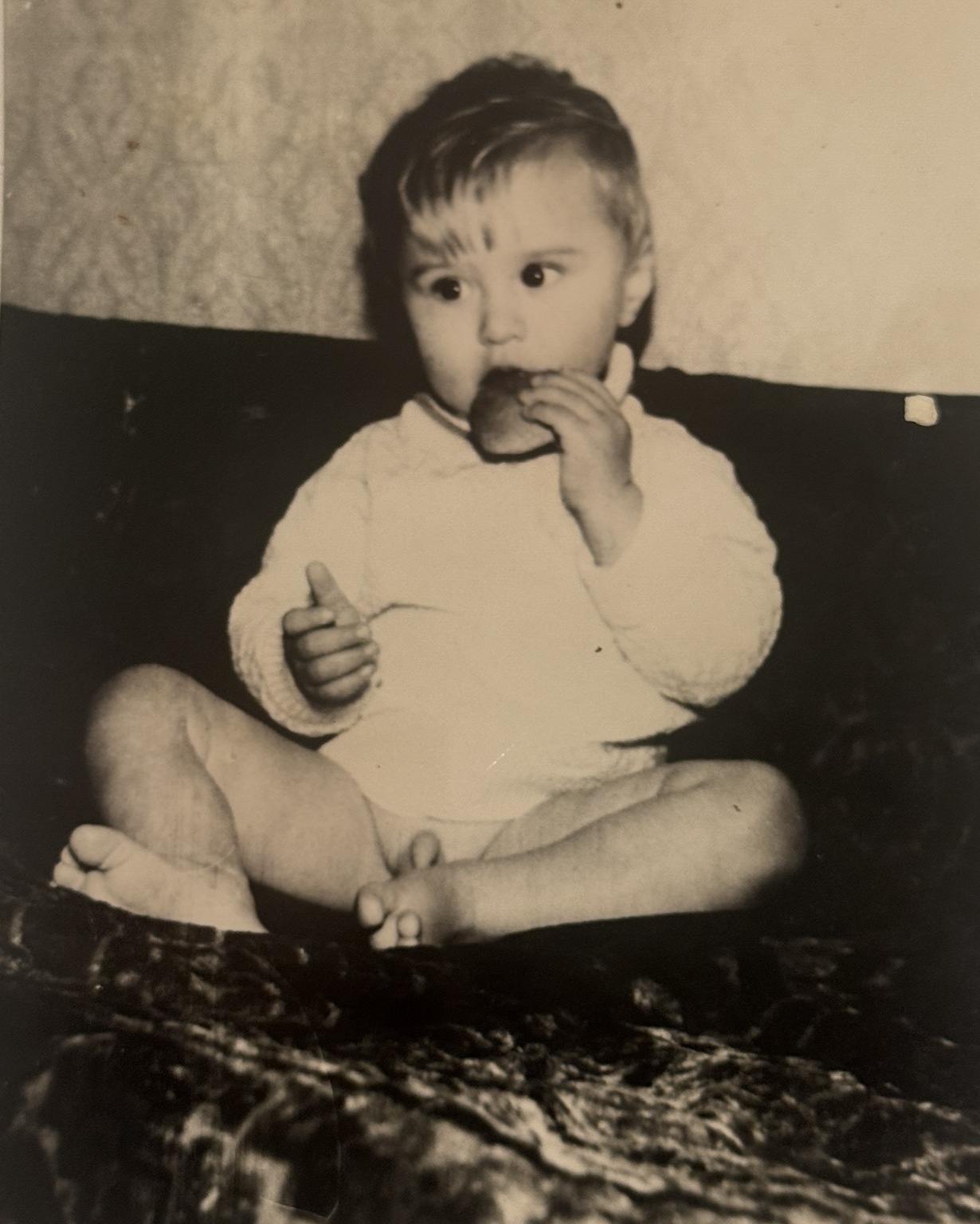
Photo: a child in a light-colored top, sitting with food held to their mouth.

What is this?

GeminiGoogle’s AI assistant

English translation

The photo shows an old black-and-white vintage photograph of a young child (a little one). The child is sitting on a sofa or bed, wearing a light-colored top or sweater and eating a piece of food (it looks like bread, a small dry bread ring, a cookie or a piece of fruit).

Original Russian text

Что это?

На фотографии изображена старая чёрно-белая винтажная фотография маленького ребёнка (малыша). Ребёнок сидит на диване или кровати, одет в светлую кофточку или свитер и ест кусочек еды (похоже на хлеб, сушку, печенье или фрукт).

Translated excerpt from a Gemini conversation. Chat layout by beforeword.

The image and the description are shown separately

A word from the answer
child
A possible explanation of that word
a young person

The photograph and Gemini’s answer appear separately above. In the answer, “child” is linked to “sitting”, “wearing” and “eating” to offer a description. Explaining “child” as “a young person” adds a different sequence of words.

An AI answer is a written form. It does not become the photograph or the person it describes: the image is shown separately from the answer. The word “photograph” is not a photograph; the word “child” in the description is not the child in the image. The phrase “the AI claims…” is a new written form too: the word “claims” does not become a claim.

This commentary is also writing.

“Letters”, “person”, “feeling” and “description” in beforeword’s explanations are also written words. The next written explanation will be a written form too. Calling it “research” does not make these words an exception.

The words “distinction” and “boundary” remain written text, as does this explanation.

Examples from other areas

03 · another way in

“Mom”: writing and a separate audio recording.

Here you can compare a written word with a separate audio recording. The words “sound” and “utterance” below belong to the written explanation; they are not the audio recording itself.

Example with audio

The written form

Mom

Three letters on the screen.

Listen to “Mom”

Open the audio file

The written word “Mom” has three letters. This part has a separate audio recording and a play button. The written “Mom” is not the spoken “Mom.” Writing “Mom” is not saying “Mom.” Writing “sound” does not create the sound.

“A person opens their mouth → air moves → audible sound is produced” is a written description. It contains “mouth”, “air” and “sound”. Those words do not play the audio recording provided here.

The phrase “a particular person” can be offered as an explanation of “Mom.” It is another entry; the word “person” in it is written too. A written form does not carry the way it is read along with it.

If the audio cannot be played or heard, what remains for this part of the example is the written word and the explanations about sound.