
Published letter · Consciousness and experience
What supports saying that two formulations “say the same thing”?
Sent · no reply publishedContext by beforeword · separate from the sent text
Why this letter was written
What prompted the letter
The letter responds to a passage in Hinton’s On Point interview transcript where a reformulation is said to mean the same thing as a sentence using “subjective experience”.
Why this matters to readers
Readers need to see what supports the claim that a change in wording preserves meaning, especially when that claim supports a further conclusion about subjective experience. The proposal keeps the sentences and the claim of equivalence open to separate examination.
What the letter asks
Using the robot-and-prism passage, the letter asks for a criterion for that equivalence and a reason for applying it in this case.
Sent letter · English transcription
The letter
Transcribed from the supplied screenshots. Screen line breaks are joined into paragraphs; wording and punctuation are retained.
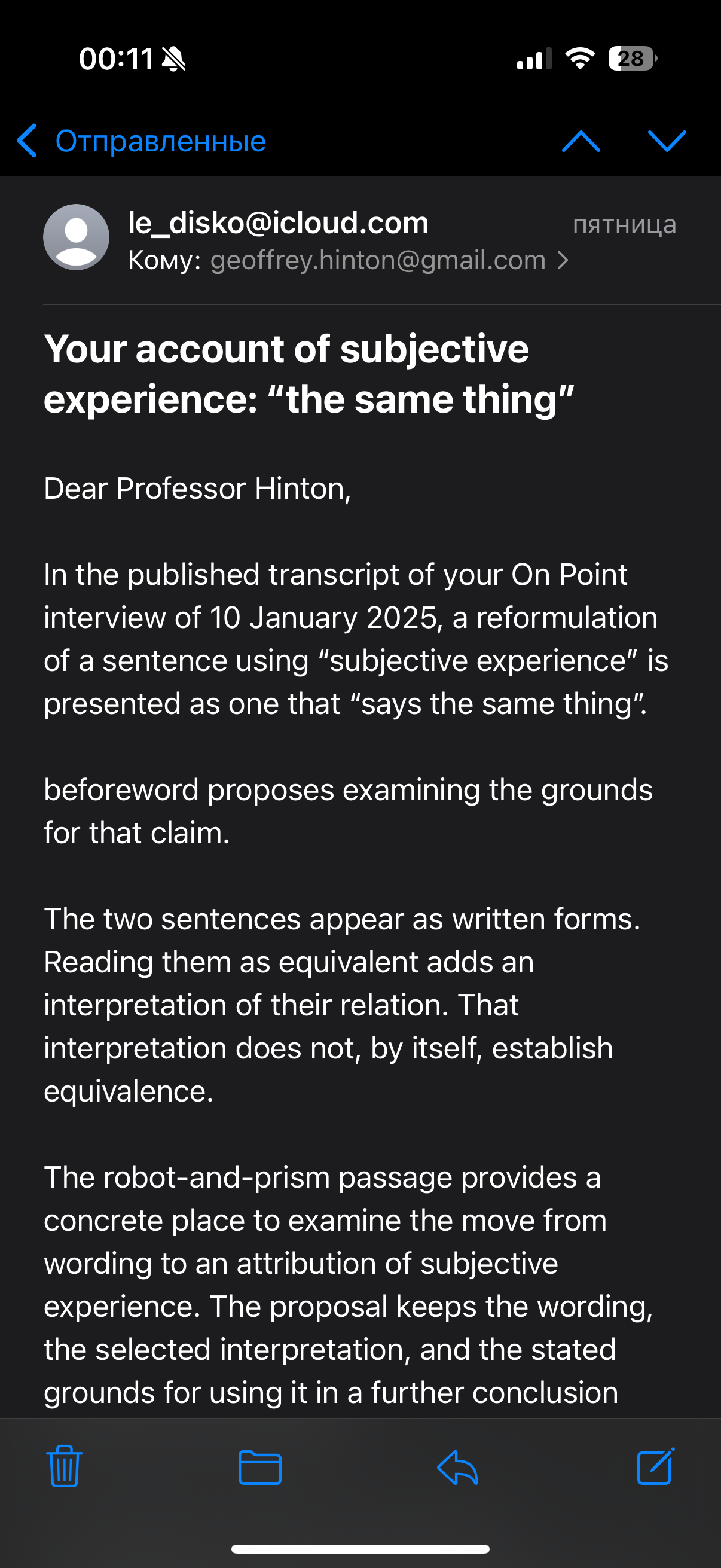
Dear Professor Hinton,
In the published transcript of your On Point interview of 10 January 2025, a reformulation of a sentence using “subjective experience” is presented as one that “says the same thing”.
beforeword proposes examining the grounds for that claim.
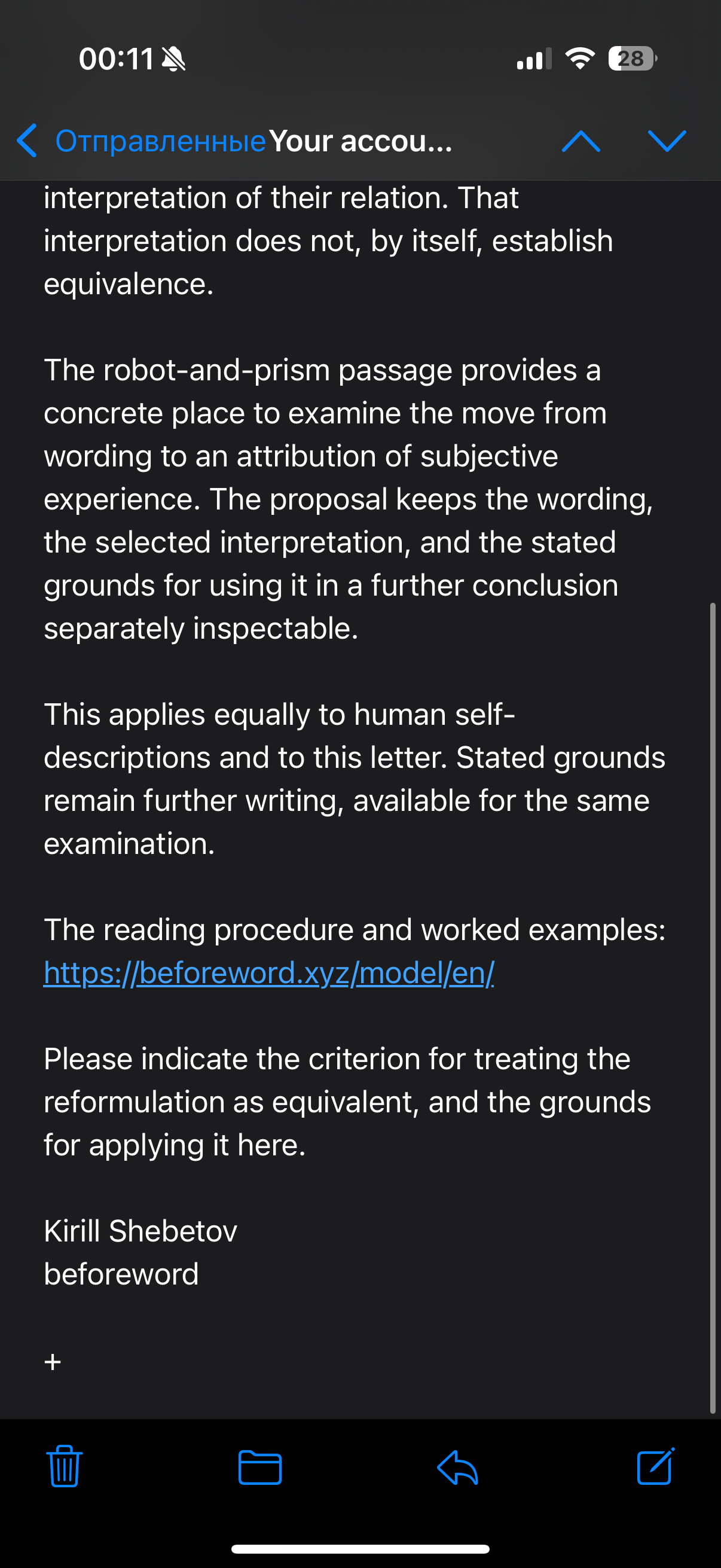
The two sentences appear as written forms. Reading them as equivalent adds an interpretation of their relation. That interpretation does not, by itself, establish equivalence.
The robot-and-prism passage provides a concrete place to examine the move from wording to an attribution of subjective experience. The proposal keeps the wording, the selected interpretation, and the stated grounds for using it in a further conclusion separately inspectable.
This applies equally to human self-descriptions and to this letter. Stated grounds remain further writing, available for the same examination.
The reading procedure and worked examples:
https://beforeword.xyz/model/en/
Please indicate the criterion for treating the reformulation as equivalent, and the grounds for applying it here.
Kirill Shebetov
beforeword
+
Publications discussed in the letter
These links are provided for reading in context. They are separate from the sent letter; beforeword’s commentary is not a reply from the recipient.
The ‘Godfather of AI’ says we can’t afford to get it wrong
On Point, 10 January 2025. End of Part II and start of Part III: the subjective-experience reformulation and prism example.
The interview transcript published by the broadcaster, WBUR.
Sending record and files
The author supplied screenshots from the Sent folder. They show the message and the available sending details. These materials do not record the recipient reading it.
View screenshots · 2
Screenshot 1 · Open full size
Screenshot 2 · Open full size


Each TXT file begins with publication details, followed by the separately marked letter text. These are screenshot transcriptions and translations, not original email files. The purpose explanation and opening question are editorial summaries by beforeword.
Correspondence record
Sending shown in the author’s materials
The header shows “Friday”; the calendar date is not displayed.
Receipt by the intended recipient and a substantive reply are not separately recorded in the published materials.
Added to the public collection
The English transcription, Russian translation and screenshots are presented separately. No replies have been published yet.
The absence of a published reply does not establish agreement, rejection or an inability to object.