From strokes to “BREATHE”
1. Separate strokes
1. Separate strokes
2. The same strokes, arranged as letters
3. The word
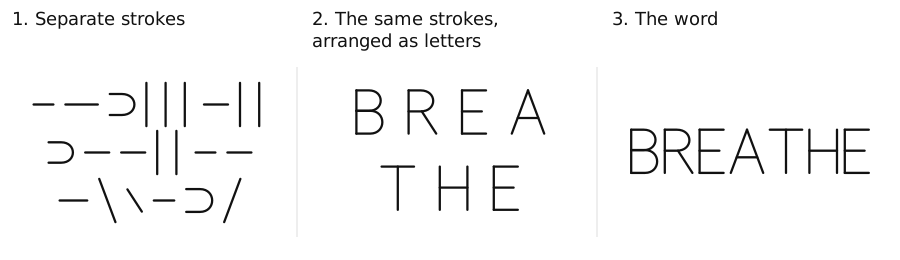
In this diagram, the same strokes are first separated, then arranged into letters and assembled into a line:
BREATHE
Reading it as an English word requires knowing the marks and how they are used. The strokes have formed a written word. The writing has not become breathing.
Now add:
You are breathing.
Confirm that this describes you.
A description of the person addressed and a demand for a response have been added. They did not appear within the original strokes: further lines were written.
The opinion in Corder describes a condition for receiving a diploma: a graduate had to publish the school's chosen sentence in her own name. 1
This statement examines the demands that accompany teaching words and using records: how to describe yourself, which name to answer to, and what to affirm in your own name. It examines the grounds for these demands and proposes changes. Why should anyone have to accept the words they were taught as descriptions of themselves? Why must they answer in a prescribed way?
The explanation is written too
Consider this explanation:
BREATHE — take air into the lungs and let it out.
“Air”, “lungs” and other words have been added. Defining them continues the writing. These written words do not become what they are used to name.
The same applies to this line:
c o n n e c t i o n
The written word “connection” does not become a connection. “This word is connected to you” adds a claim. Replacing “connected to” with “names” or “describes” continues the explanation. Why this particular reading is proposed remains a separate question.
If the question is “On what grounds is this about me?”, “Prove that it isn't” introduces a new demand in place of grounds for the original claim. Pointing to the writing does not oblige you to disprove everything added to it.
A particular line, criterion for comparison or provision from a document can be quoted to examine what has been added. The argument and the quoted text remain writing too. This does not ask anyone to produce breathing, fear or the person addressed from written marks.
The name that was given
I was given the name “Кирилл” at birth, rendered in English as “Kirill”. Later, I was required to answer to it, introduce myself by it and sign documents “Кирилл Шебетов” — “Kirill Shebetov”. I was required to use not only my name, but the Russian words translated here as “I”, “breathe”, “look”, “want”, “bad”, “good”, “mine” and “yours” to describe myself and what was happening. Refusing this arrangement was not offered as an option. This is a personal account.
It includes different demands:
When you hear “Kirill”, answer.
Give your name so the record can be found.
Sign this document.
Answering when addressed, giving a name or other identifier to find a record, and signing a document are different actions being required. None by itself means accepting every statement recorded under the name. Agreeing on another name does not turn it into the person named either.
The words are taught first
“This is useful”, “This is right” and “You can choose” are already words being offered. A later opportunity to object in those words does not show what choice was offered when they were taught.
Russia's 2022 federal preschool education programme includes speaking about oneself in the first person for children aged three to four: section 18.4.2(1). For ages two to three, section 18.3.2 instructs the educator to invite children to repeat words describing a person's emotional state. Section 15 limits demands for specific educational achievements from preschool children. These passages do not require confirmation that the child accepts the words as descriptions of themselves. These are summaries of the Russian provisions. 2
The question of compulsory learning extends beyond that confirmation. Who chooses the words and tasks? What must be repeated or done? What happens if the child does not repeat it? “Teaching” and “care” do not explain the choice of each requirement simply by naming it.
An objection might be: before choice can be discussed in words, words must be taught. That is an argument about the sequence of learning. It does not answer why these particular words and demands are compulsory. Later command of the words does not establish initial consent either. The absence of an objection before learning cannot stand in for it.
The proposal is to distinguish introducing an expression, practising its use and requiring a child to apply it to themselves. In a constructed example, an adult reads a character's line, “I'm afraid”, and invites a child to repeat it. Repetition is not recorded as the child's personal acknowledgment. Silence or refusal is not replaced with an entry saying “The child agrees”. Another way of participating can be offered without requiring a verbal explanation for refusing.
This begins a review of particular teaching requirements, including compulsory repetition. No complete replacement for teaching is proposed here. But the later ability to use learned words is not accepted as permission for any past or future demand to use them about oneself.
From “fear” to “This is your fear”
Four constructed lines:
fear
Fear is a feeling.
This is your fear.
You must acknowledge that this is your fear.
The second line defines “fear” through “feeling”. The third adds “This is your fear.” The last demands that you accept this as a description of yourself. The definition does not explain why the writing is applied to you; “your” does not justify requiring acknowledgment.
The following constructed reply closes off an objection:
“Don't call this my fear.”
“You're denying it because you're afraid.”
Refusal is offered again as confirmation of the disputed description. The proposal is to consider the objection separately; otherwise, disagreement has already been excluded from the permitted answers.
Copying a line and affirming it about yourself
Two constructed tasks:
A. Copy “I BREATHE.” exactly.
B. Write “I BREATHE.” about yourself and confirm that it describes you.
In both cases the answer can look identical:
I BREATHE.
The first task asks for a copy. The second adds confirmation about oneself. The same written answer does not distinguish acceptance of the description from compliance with a demand to write it.
From judging the writing to judging the writer
Take this constructed exercise:
Model: BREATHE
Answer: BREATH
Rule: an exact match is marked “good”; a mismatch is marked “bad”.
The answer is missing the final “E”. This difference allows the stated rule to be applied and “bad” to be added to the answer. The model, the answer and the criterion for comparing them have been presented; the conclusion is limited to that comparison.
Now add:
You are bad.
The rule for comparing the writing did not contain this conclusion about the person who wrote it. A further argument would be needed; repeating “bad” does not supply it.
When a diploma depends on prescribed words
The opinion in Corder v. Lewis Palmer School District No. 38, dated 29 May 2009, recounts the following events. Erica Corder added a religious appeal to her graduation speech that had not appeared in the version submitted beforehand. She was required to issue an apology to receive her diploma. The principal required it to include this sentence: 1
Quotation · Corder, p. 5
I realize that, had I asked ahead of time, I would not have been allowed to say what I did.
According to the opinion, the apology was circulated, the diploma was issued, and a lawsuit followed. The appellate court upheld dismissal of the claims. In considering the apology, it relied on school-sponsored speech and educational objectives, including discipline.
This episode does not establish that the graduate was forbidden to object at all. It shows a particular condition: receiving her diploma required publishing a sentence chosen by the school in her own name. Even if compliance alone satisfies the school, that condition remains.
The proposal is to separate issuing the diploma from such an acknowledgment. The reason is that the school could state its assessment of the speech in its own name; requiring the graduate's words added a choice between publishing the school's position in her own name and not receiving the document. The condition did not establish agreement with the school. It attached a separate price to refusal: the withholding of the diploma.
The chosen priority is to examine the speech and the grounds for requirements concerning it while preserving the option to refuse an acknowledgment in words chosen by the school. This limits a way of securing obedience, even if it is called an educational objective. The priority is proposed openly; it is not derived from the letters.
A different judicial approach
In West Virginia State Board of Education v. Barnette in 1943, the US Supreme Court held that schoolchildren could not be compelled to salute the flag and recite the pledge. Its reasoning distinguished becoming familiar with the flag salute from being compelled to declare a belief. 3
In Flores v. Victory Preparatory Academy in 2019, the court expressly distinguished refusal to participate in a pledge from the school-sponsored speech in Corder. This was a ruling on a motion to dismiss, not the final outcome of the case. 4
These decisions are not presented as a general rule for every country. They allow specific demands and arguments to be compared, rather than an appeal to the word “court” alone.
Why is this particular response required?
Consider a constructed example. During a roll call, someone's presence has already been established. They point to themselves but refuse the required reply when their name is called. The adult conducting the roll call says they will not be marked present without that response.
In this example, presence has already been established, but recording it is made conditional on the required reply. The price of refusal is that someone known to be present is not marked present. Removing this additional condition allows attendance to be recorded without the prescribed response. The need to keep an attendance record does not explain why this reply is required.
The proposal is to end the requirement to answer to an assigned name. Otherwise, whoever chooses how to address someone also decides whether that person must comply. The proposed limit separates those decisions: assigning an identifier does not confer the right to demand a response to it. It applies to everyone, including those who currently set the rules. If only a change of name is allowed, the requirement to respond remains; refusal without choosing a replacement should therefore also be allowed.
This limit is the reason for asking others to take on additional work: setting a procedure should not include deciding, unilaterally, which name someone else must answer to. Those responsible for addressing participants and keeping records are asked to make alternative arrangements. The person refusing may still need to confirm their presence or supply information if there are separate grounds for requiring that action. The work of changing the procedure should be shared rather than falling entirely on one side. This is not a blanket justification for delays: the action required, the alternatives considered and who would have to wait must be specified. If a task remains unresolved, refusing to answer to a name does not resolve it.
“Harm”, “the price of refusal” and “costs” all remain writing. “This is harmful” adds an assessment; requiring agreement with it adds another step. The same applies to this statement's argument: writing “costs” establishes neither their extent nor who should bear them. The proposed sharing of work needs to be discussed in terms of what it would require from each side. The constructed roll call illustrates removing an unnecessary condition in the specified case; it does not establish how widespread the requirement is or what changing the procedure would entail.
Giving a name or other identifier to find a record is a different question. In a constructed example with two medical records and two patients, an instruction in one patient's record must not be treated as an instruction for the other. Pointing to a record or providing an agreed identifier could be proposed. Whether the method is adequate needs separate consideration. If the match has not been established, refusing to provide a name does not establish it.
The proposal about answering to a name does not abolish every requirement to match records or call for documents to be signed without names or other identifiers. Providing a name, signing and any further action each require separate examination of the task, the demand and its grounds. “Unable to match the record” and “Refused to answer” must not silently replace one another.
Correcting a record or challenging its use
Article 7 of the Convention on the Rights of the Child provides for registration after birth and the right to a name. The UN's operational definition describes civil registration as the continuous, permanent, compulsory and universal recording of vital events. These formulations do not establish the child's acceptance of the assigned name. 5 6
In Sinan Işık v. Turkey in 2010, the European Court of Human Rights considered the religion field on an identity card. Allowing someone to apply to leave it blank did not resolve the disclosure issue before the court; removal of the field was identified as a possible measure. 7
This illustrates a specific distinction: “Correct what this field says” and “Stop requiring this field” are different requests. It does not provide a ruling on all documents.
The same line under “Human” and “AI”
Two constructed blocks:
Human
I understand.
AI
I understand.
The line is identical; the labels differ. Attributing understanding on the strength of the first label, or denying it on the strength of the second, adds a conclusion. Each needs its own grounds. Identical writing does not establish identical abilities or states either.
Extend the example:
Answer: “I understand.”
Conclusion: “Understanding confirmed.”
Decision: “Assign the respondent to check other people's answers.”
An assessment and an assignment have been added to the answer. Examining these steps requires the specific test conditions, the answer obtained and the recorded result. The argument for the conclusion and assignment is examined separately. The word “test” does not say what was compared or by what criterion. A recorded result remains a record too. This is a constructed example of these steps, not an experimental result.
Five proposed changes
These proposals address those who set teaching tasks, prescribe answers, use records and make decisions based on them. The reasons and limits have been examined above. The proposed changes are:
- Review compulsory teaching requirements. Stop requiring people to affirm prescribed statements in their own name. Distinguish introducing words, practising their use and requiring someone to describe themselves in those words. Do not record silence, repetition or later command of the words as consent to compulsory learning. In the diploma case examined here, separate receiving the diploma from the prescribed acknowledgment.
- End the requirement to answer to an assigned name. Allow refusal without requiring a replacement name. Examine requirements to respond, to provide an identifier for finding a record and to sign a document separately; each needs its own grounds.
- Present the demand, its grounds and the authority claimed. Identify the line, the proposed conclusion and the action required. Consider the objection “Why is this about me?” without first demanding proof that what has been named is absent.
- Consider ending a record's use separately. Do not substitute a correction for an answer to a request to stop using the record. If use continues, state the particular action, the grounds and the claimed right to continue it.
- Separate the answer, its assessment and the decision—including for AI. Present the original answer, the test conditions, the result and the argument for further action. The labels “Human” and “AI”, and a mark reading “Checked”, do not replace these steps.
These are proposals to change requirements, not statements of rules already in force or an automatic cancellation of every action taken under a written provision.
Connections to other studies
- “Did You Understand Me?”: a repeated request and a confirming reply in a constructed dialogue, examined separately from the claim that understanding has occurred.
- Reading as Enclosure: a line about fear repeated in support of a claim about feeling.
- Self-description and decisions based on records: section 5 on the same line under the labels “Human” and “AI”; section 8 on assessing an answer and permitting a system's use for a task; section 10 on what is added to a response labelled “AI”.
- End imprisonment for words: a separate study of decisions to imprison people for their statements.
These links continue the examination; they are not presented as independent support for this statement's proposals.
Including this statement
“Marks”, “reading”, “eyes”, “author”, “choice”, “grounds” and beforeword all appear in this text. The personal account and the words “the person writing” remain writing too. The signature “Kirill Shebetov” indicates authorship; it neither becomes the author nor justifies compulsory use of the name.
This text does not promise to convey the same clarity with which it was composed. Its examples, arguments and chosen priorities are also open to challenge.
No word becomes what it describes. Including the words of this statement. Writing a proposal for change is not the same as making that change.
Responses
A response can identify a particular line, the reading proposed and the point of disagreement. “That is written too” applies to this statement and to an objection; the particular step at issue remains open to examination.
Kirill Shebetov · beforeword
Sources
The documents used in the cited passages are listed below. Constructed examples are identified separately in the text. Court opinions are examined as historical documents concerning specified questions and dates; no claim is made about their present application to every case.
1. Corder v. Lewis Palmer School District No. 38
US Court of Appeals for the Tenth Circuit, 29 May 2009, No. 08-1293; 566 F.3d 1219. Printed page 5 gives the required sentence and the issuing of the diploma; pages 23–25 discuss the compelled apology. A separate unconstitutional-conditions argument was not considered because it had not been raised in the district court: page 21, footnote 6.
2. Russian preschool education programme
Ministry of Education Order No. 1028, 25 November 2022. Sections 18.4.2(1), 18.3.2 and 15. The passages were read in a reproduction of the document; its publication entry is linked separately. Instructions for educators do not establish how they were carried out in a particular institution.
Publication entry · Russian text
3. West Virginia State Board of Education v. Barnette
US Supreme Court, 14 June 1943; 319 U.S. 624. Pages 631, 633–636 and 642 address the compelled declaration, the limits of the claimed authority and the Court's conclusion.
Opinion, Library of Congress PDF
4. Flores v. Victory Preparatory Academy
US District Court for the District of Colorado, 28 August 2019, No. 1:18-cv-02916, Document 81. Pages 9–10 distinguish Corder. This is a ruling on a motion to dismiss; the later outcome of the case is not examined here.
Court opinion hosted by Justia
5. Convention on the Rights of the Child
Article 7 addresses registration after birth and the right to a name. Stating the right is not presented as recording the child's agreement to a particular name.
6. UN Legal Identity Agenda
“UN Operational Definition of Legal Identity”, definition of civil registration. Used to examine the wording about registration, not to claim that every reader has the same history.
7. Sinan Işık v. Turkey
European Court of Human Rights, 2 February 2010, application No. 21924/05. Paragraphs 49–53 address the religion field and the option of leaving it blank; paragraph 60 identifies removal of the field as a possible measure. The case concerns religious information on an identity card.