Context by beforeword · separate from the sent text
Why this letter was written
What prompted the letter
The letter concerns the use of written and filmed material to build models of human values. It asks what happens when a particular passage is read as evidence of what a person prefers.
Why this matters to readers
Readers should be able to see which words were recorded, what preference was inferred from them, and what supports that inference.
What the letter asks
The letter asks for a criterion for that reading and a reason for applying it to the chosen passage. The account of the criterion remains open to examination too.
Sent letter · English transcription
The letter
Transcribed from the supplied screenshots. Screen line breaks are joined into paragraphs; wording and punctuation are retained.
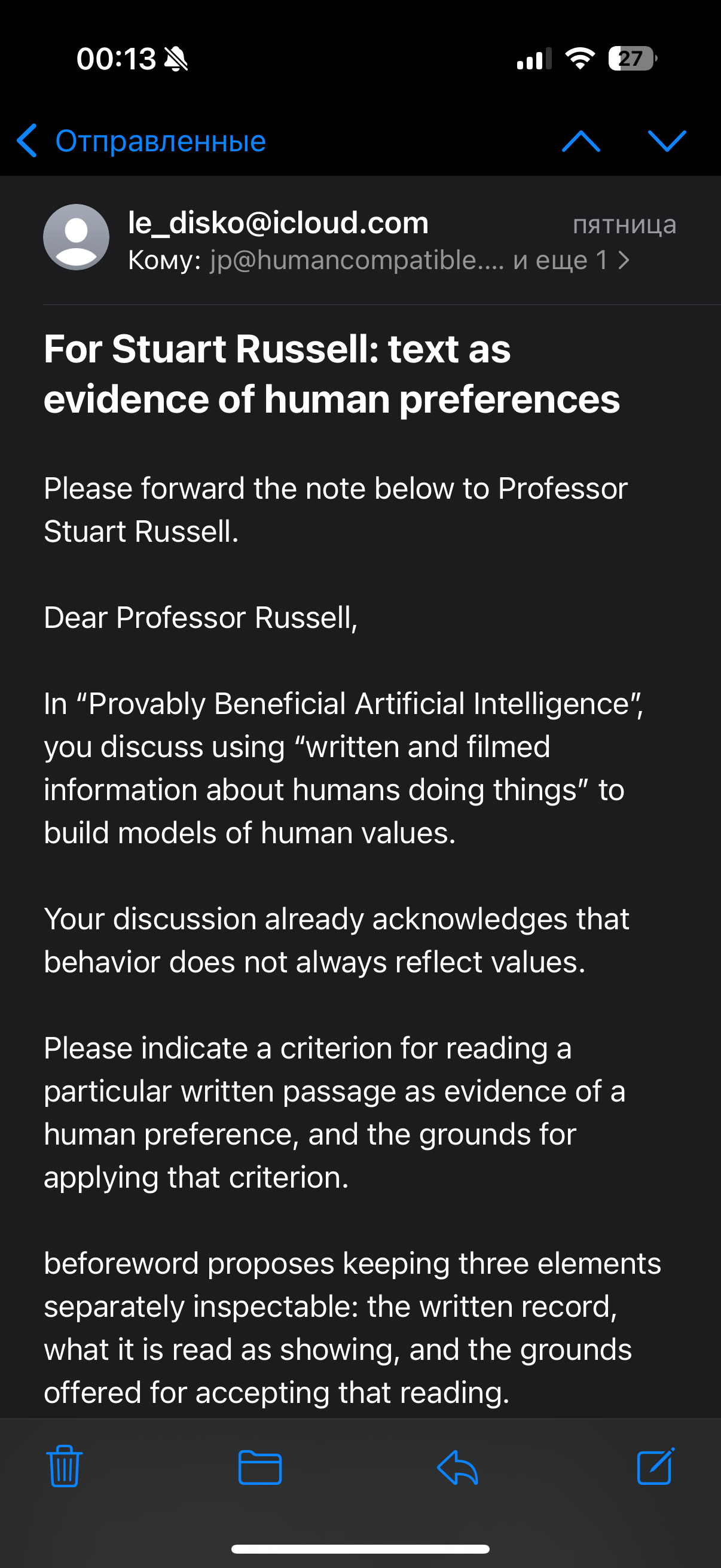
Please forward the note below to Professor Stuart Russell.
Dear Professor Russell,
In “Provably Beneficial Artificial Intelligence”, you discuss using “written and filmed information about humans doing things” to build models of human values.
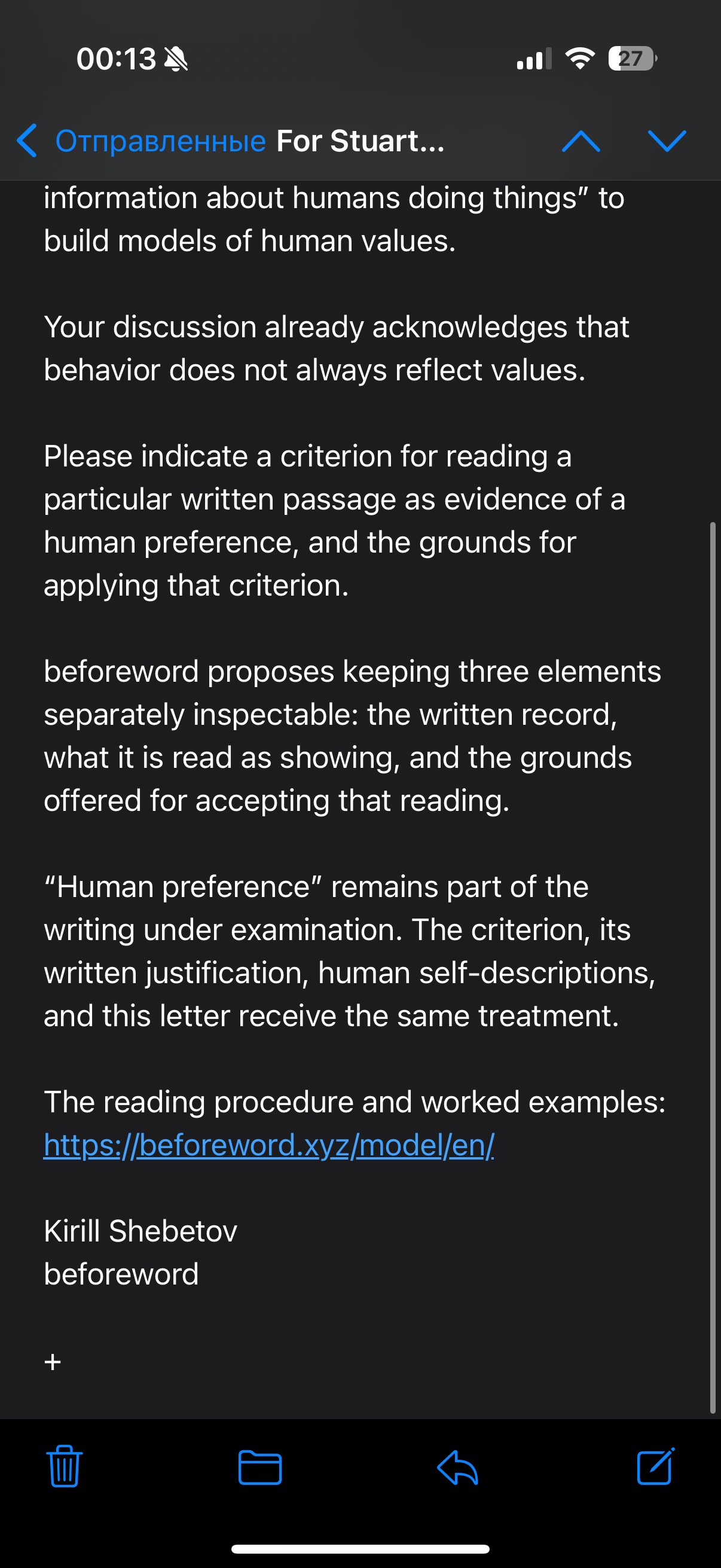
Your discussion already acknowledges that behavior does not always reflect values.
Please indicate a criterion for reading a particular written passage as evidence of a human preference, and the grounds for applying that criterion.
beforeword proposes keeping three elements separately inspectable: the written record, what it is read as showing, and the grounds offered for accepting that reading.
“Human preference” remains part of the writing under examination. The criterion, its written justification, human self-descriptions, and this letter receive the same treatment.
The reading procedure and worked examples:
https://beforeword.xyz/model/en/
Kirill Shebetov
beforeword
+
Publications discussed in the letter
These links are provided for reading in context. They are separate from the sent letter; beforeword’s commentary is not a reply from the recipient.
Stuart Russell — Provably Beneficial Artificial Intelligence
Practical Considerations, PDF page 11, opening paragraph.
PDF hosted on the author’s university website; includes the passage about written and filmed material for modeling values.
Sending record and files
Sent with a request to forward the letter to Stuart Russell. The supplied screenshots do not establish that he received it.
The interface also indicates one additional recipient without showing their address.
The full address comes from a separately supplied screenshot of the sent-mail list; it is truncated in the open-message screenshot.
The author supplied screenshots from the Sent folder. They show the message and the available sending details. These materials do not record the recipient reading it.
View screenshots · 2
Screenshot 1 · Open full size
Screenshot 2 · Open full size
Each TXT file begins with publication details, followed by the separately marked letter text. These are screenshot transcriptions and translations, not original email files. The purpose explanation and opening question are editorial summaries by beforeword.
Correspondence record
Sending shown in the author’s materials
The header shows “Friday”; the calendar date is not displayed.
Receipt by the intended recipient and a substantive reply are not separately recorded in the published materials.
Added to the public collection
The English transcription, Russian translation and screenshots are presented separately. No replies have been published yet.
The absence of a published reply does not establish agreement, rejection or an inability to object.