Published letter · Explanation and grounds
What supports saying that a reader knows a claim is true?
Sent · no reply publishedContext by beforeword · separate from the sent text
Why this letter was written
What prompted the letter
The letter addresses Williamson’s quoted thesis about knowledge as evidence. It asks how a written supporting statement justifies saying that a reader knows a particular claim is true.
Why this matters to readers
This matters when assessing an argument: an added explanation has its own wording, interpretation and claimed role in supporting a conclusion.
What the letter asks
The letter asks for one sentence, a proposed reading and a supporting statement, followed by an account of how that support warrants attributing knowledge to the reader. Calling the statement a justification is also open to examination.
Sent letter · English transcription
The letter
Transcribed from the supplied screenshots. Screen line breaks are joined into paragraphs; wording and punctuation are retained.
Dear Professor Williamson,
In “Knowledge as Evidence”, you write: “knowledge, and only knowledge, constitutes evidence”.
The reading proposed here treats E = K as a substantive thesis and includes your rejection of an infallible test for identifying evidence.
A written explanation adds another formulation. beforeword asks that its interpretation and its role in supporting the original claim be made explicit. The label “justification” is itself part of what is being examined.
Please indicate, using one sentence from this letter, a proposed reading and one supporting statement, explaining how that statement would support attributing to a reader knowledge that the claim, so interpreted, is true.
The supporting statement would extend the written record. Its wording, its interpretation, and its proposed evidential role would remain separately inspectable.
This examination also includes any stated criteria, descriptions of observations, human self-descriptions, and the wording of beforeword’s own procedure. This letter and its terms “writing”, “reading”, “knowledge” and “evidence” receive the same treatment.
The reading procedure and worked examples:
https://beforeword.xyz/model/en/
Kirill Shebetov
beforeword
+
Publications discussed in the letter
These links are provided for reading in context. They are separate from the sent letter; beforeword’s commentary is not a reply from the recipient.
Timothy Williamson — Knowledge as Evidence
P. 718: E = K; pp. 722–723: no infallible method for identifying knowledge.
Copy of the Mind 106(424), 1997, pp. 717–741 article, hosted in Branden Fitelson’s teaching materials.
Knowledge as evidence — Mind / Oxford University Press
Publisher’s article page; DOI 10.1093/mind/106.424.717.
Publication details; an openly readable copy is linked separately above.
Sending record and files
The interface also indicates one additional recipient without showing their address.
The address is truncated in the supplied screenshots. A complete address has not been reconstructed here.
The author supplied screenshots from the Sent folder. They show the message and the available sending details. These materials do not record the recipient reading it.
View screenshots · 2
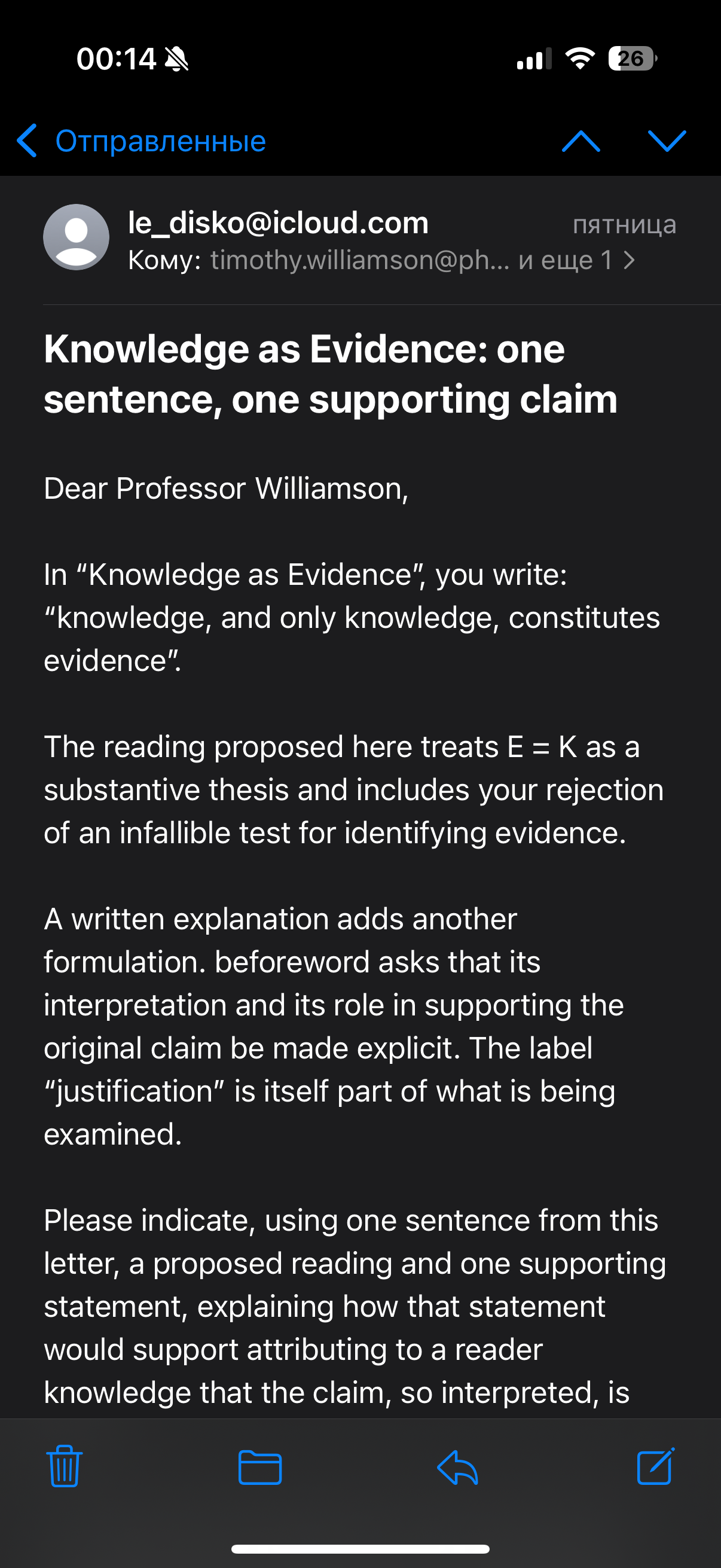
Screenshot 1 · Open full size
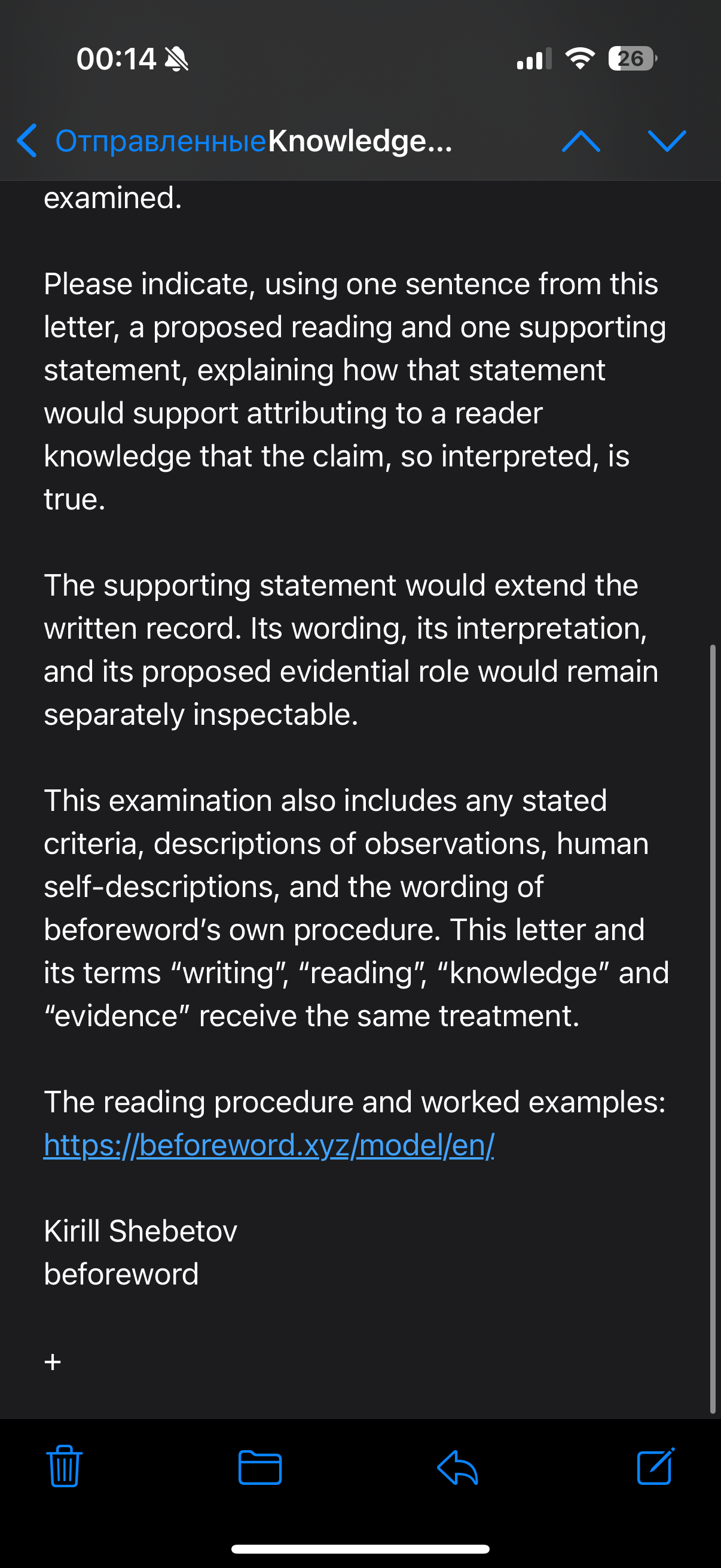
Screenshot 2 · Open full size


Each TXT file begins with publication details, followed by the separately marked letter text. These are screenshot transcriptions and translations, not original email files. The purpose explanation and opening question are editorial summaries by beforeword.
Correspondence record
Sending shown in the author’s materials
The header shows “Friday”; the calendar date is not displayed.
Receipt by the intended recipient and a substantive reply are not separately recorded in the published materials.
Added to the public collection
The English transcription, Russian translation and screenshots are presented separately. No replies have been published yet.
The absence of a published reply does not establish agreement, rejection or an inability to object.