
Published letter · Explanation and grounds
What distinguishes changing the words from changing the explanation?
Sent · no reply publishedContext by beforeword · separate from the sent text
Why this letter was written
What prompted the letter
The letter responds to a quoted criterion for a good explanation: it is hard to vary while still accounting for what it purports to explain. It asks how that criterion distinguishes a change in wording from a change in the explanation.
Why this matters to readers
Readers comparing two formulations need to see what supports saying that the explanation has stayed the same or has changed.
What the letter asks
The letter asks for one short example showing and justifying that distinction. The wording and interpretation of the criterion itself remain open to examination.
Sent letter · English transcription
The letter
Transcribed from the supplied screenshots. Screen line breaks are joined into paragraphs; wording and punctuation are retained.
Dear Professor Deutsch,
In the glossary to The Beginning of Infinity, you characterize a good explanation by how hard it is to vary “while still accounting for what it purports to account for”.
Please indicate, using one short example, what distinguishes a change of wording from a change of explanation when applying your criterion, and the grounds for that distinction.
beforeword proposes keeping three elements separately inspectable: the written formulations, the explanatory content attributed to them, and the grounds offered for that attribution.
The terms “explanation” and “knowledge” remain part of the writing under examination. The criterion’s own wording and interpretation, descriptions of criticism and experiment, human self-descriptions, and this letter receive the same treatment.
The reading procedure and worked examples:
https://beforeword.xyz/model/en/
Kirill Shebetov
beforeword
+
Publications discussed in the letter
These links are provided for reading in context. They are separate from the sent letter; beforeword’s commentary is not a reply from the recipient.
David Deutsch — The Beginning of Infinity: Glossary
Glossary entry: Good/bad explanation.
Glossary on the book’s website, carrying David Deutsch’s copyright notice; includes the criterion discussed.
Sending record and files
The interface also indicates one additional recipient without showing their address.
The full address comes from a separately supplied screenshot of the sent-mail list; it is truncated in the open-message screenshot.
The author supplied screenshots from the Sent folder. They show the message and the available sending details. These materials do not record the recipient reading it.
View screenshots · 2
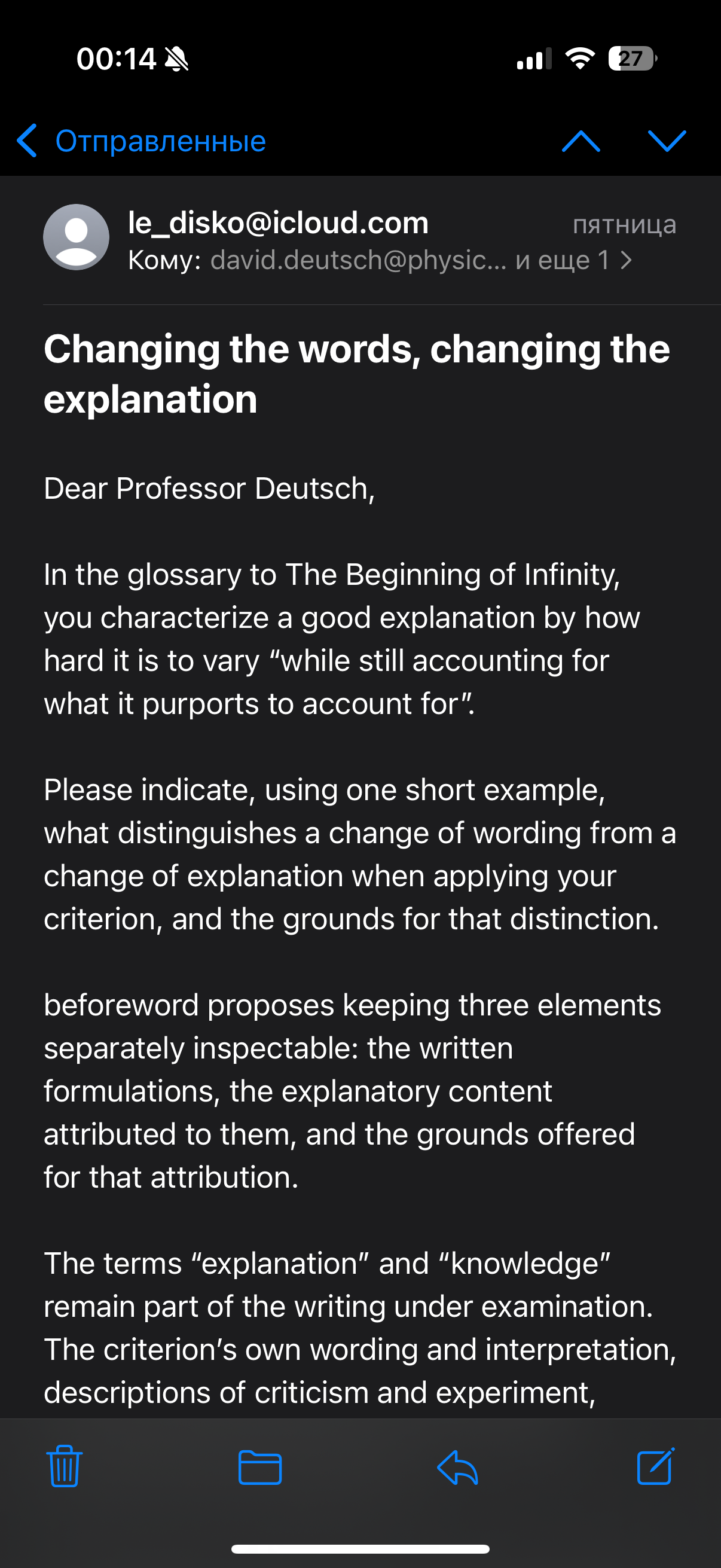
Screenshot 1 · Open full size
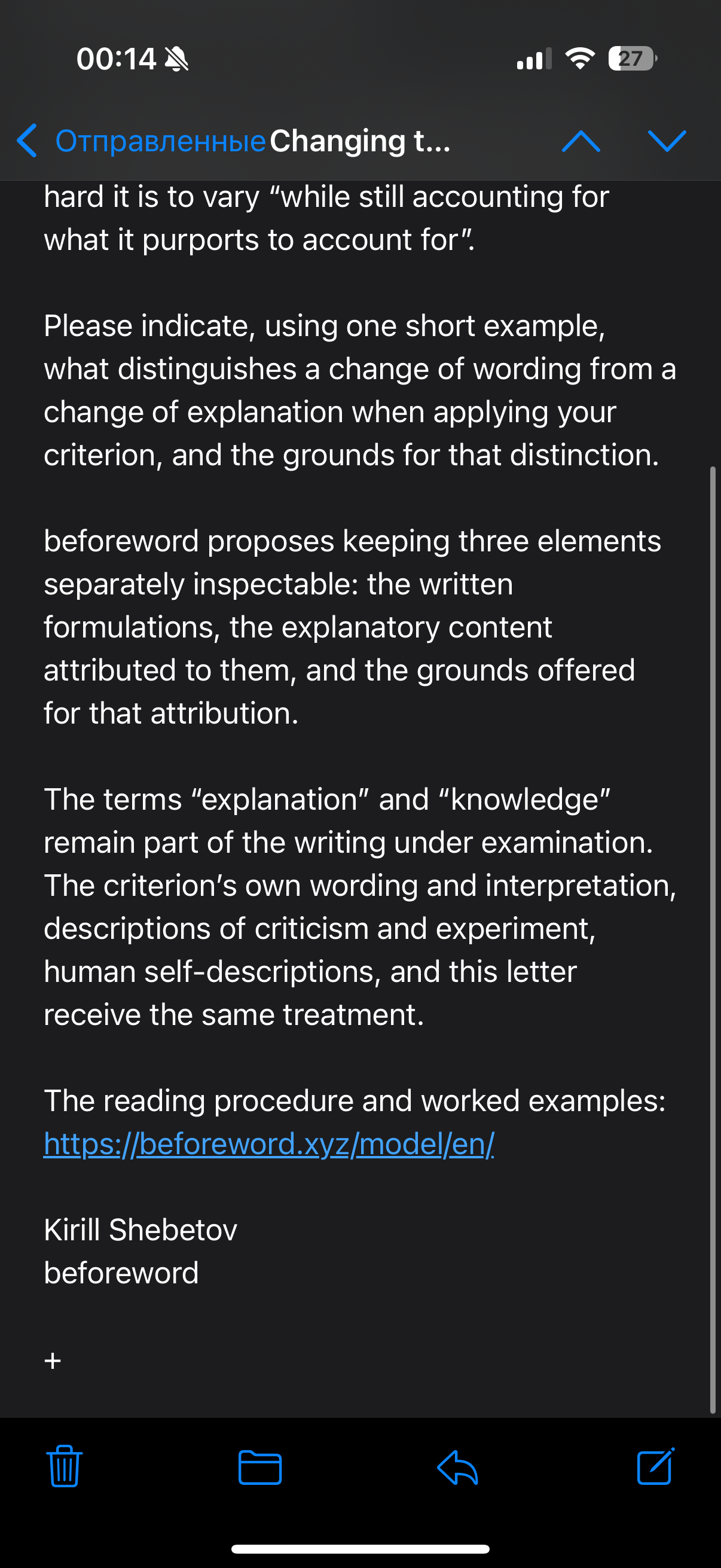
Screenshot 2 · Open full size


Each TXT file begins with publication details, followed by the separately marked letter text. These are screenshot transcriptions and translations, not original email files. The purpose explanation and opening question are editorial summaries by beforeword.
Correspondence record
Sending shown in the author’s materials
The header shows “Friday”; the calendar date is not displayed.
Receipt by the intended recipient and a substantive reply are not separately recorded in the published materials.
Added to the public collection
The English transcription, Russian translation and screenshots are presented separately. No replies have been published yet.
The absence of a published reply does not establish agreement, rejection or an inability to object.