
Published letter · Language and reading
What supports attributing mutual knowledge in a shared viewing task?
Sent · no reply publishedContext by beforeword · separate from the sent text
Why this letter was written
What prompted the letter
The letter concerns a study of watching a video together. It focuses on the move from reported differences in children’s behavior to the conclusion that the children understood that both participants knew they were watching together.
Why this matters to readers
Readers need to distinguish the comparison’s reported results from a conclusion about what the participants knew about each other. Showing how the results support that particular conclusion makes the distinction clearer.
What the letter asks
The letter asks for the strongest support in the reported experimental comparison. Descriptions of methods, measurement records and the chosen criteria remain open to examination too.
Sent letter · English transcription
The letter
Transcribed from the supplied screenshots. Screen line breaks are joined into paragraphs; wording and punctuation are retained.
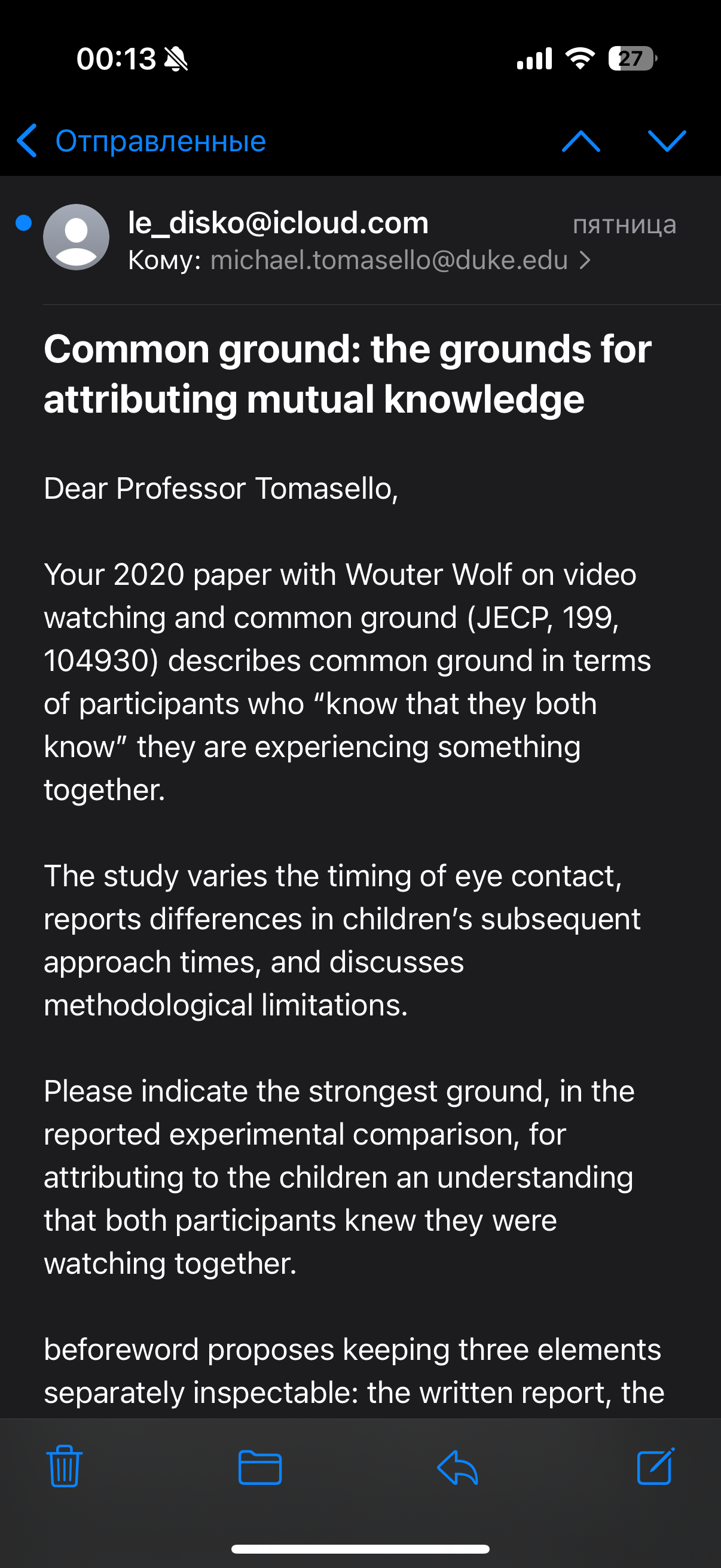
Dear Professor Tomasello,
Your 2020 paper with Wouter Wolf on video watching and common ground (JECP, 199, 104930) describes common ground in terms of participants who “know that they both know” they are experiencing something together.
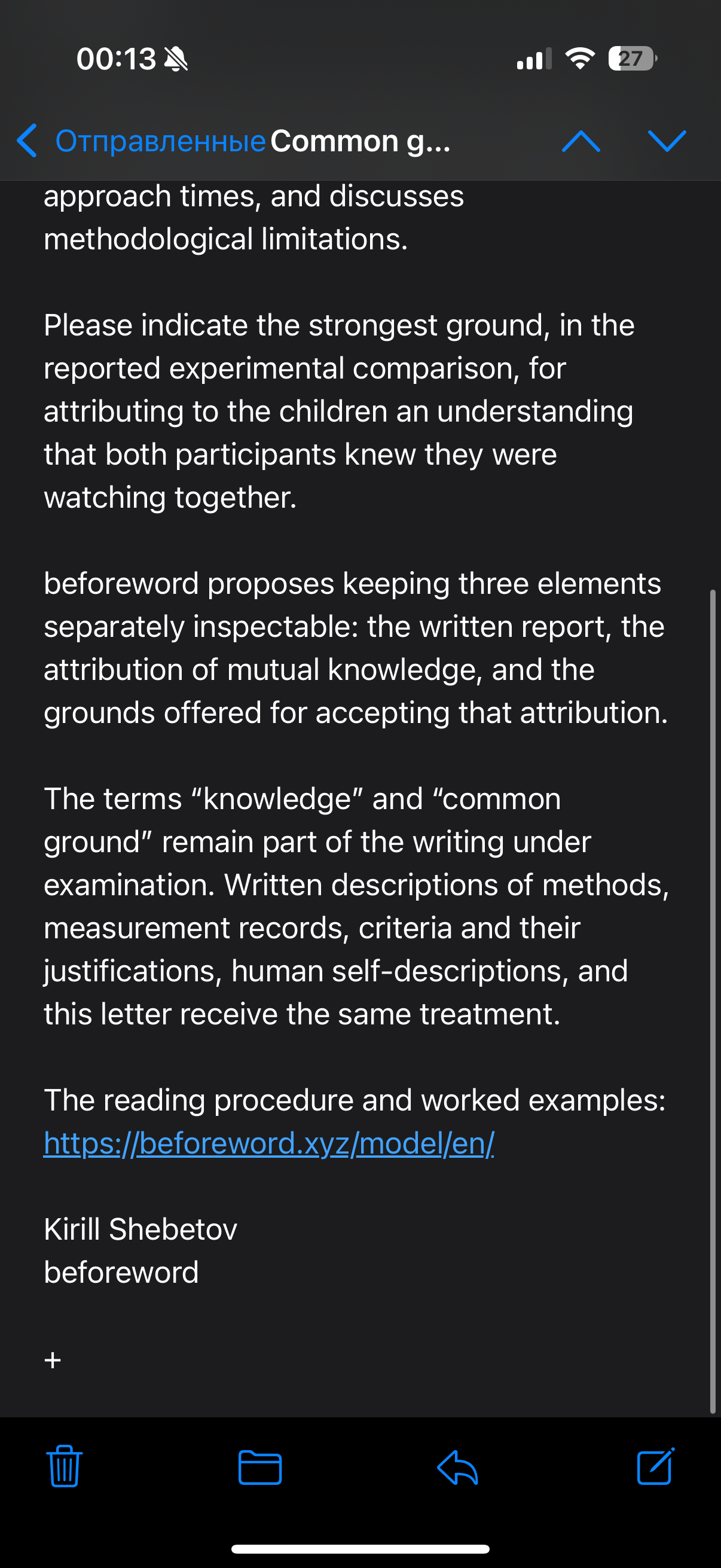
The study varies the timing of eye contact, reports differences in children’s subsequent approach times, and discusses methodological limitations.
Please indicate the strongest ground, in the reported experimental comparison, for attributing to the children an understanding that both participants knew they were watching together.
beforeword proposes keeping three elements separately inspectable: the written report, the attribution of mutual knowledge, and the grounds offered for accepting that attribution.
The terms “knowledge” and “common ground” remain part of the writing under examination. Written descriptions of methods, measurement records, criteria and their justifications, human self-descriptions, and this letter receive the same treatment.
The reading procedure and worked examples:
https://beforeword.xyz/model/en/
Kirill Shebetov
beforeword
+
Publications discussed in the letter
These links are provided for reading in context. They are separate from the sent letter; beforeword’s commentary is not a reply from the recipient.
Wouter Wolf & Michael Tomasello — Human children, but not great apes, become socially closer by sharing an experience in common ground
Introduction, PDF pages 2–3; General discussion, PDF page 9.
JECP 199 (2020), 104930; full text hosted by the Tomasello Lab at Duke.
Sending record and files
The author supplied screenshots from the Sent folder. They show the message and the available sending details. These materials do not record the recipient reading it.
View screenshots · 2
Screenshot 1 · Open full size
Screenshot 2 · Open full size


Each TXT file begins with publication details, followed by the separately marked letter text. These are screenshot transcriptions and translations, not original email files. The purpose explanation and opening question are editorial summaries by beforeword.
Correspondence record
Sending shown in the author’s materials
The header shows “Friday”; the calendar date is not displayed.
Receipt by the intended recipient and a substantive reply are not separately recorded in the published materials.
Added to the public collection
The English transcription, Russian translation and screenshots are presented separately. No replies have been published yet.
The absence of a published reply does not establish agreement, rejection or an inability to object.